The Ponir Journal
Journal Entry · 02
What is Aushtogram Ponir?

When I tell people in Ottawa that I make ponir, most of them nod politely and assume I mean something like Indian paneer. I have learned to pause at that point and say — no, it is not the same thing. Not even close. This entry is for everyone who has never heard of Aushtogram ponir. And for those who have eaten it all their lives but never stopped to think about where it comes from, how it is made, and why it is unlike anything else you will find anywhere in the world.
The place
Aushtogram is a small upazila — a subdistrict — in Kishoreganj, in the heart of Bangladesh’s haor country. To understand the cheese, you first have to understand the haors.
The haors are vast, shallow wetland basins that flood completely during the monsoon season and recede in winter to reveal miles of flat, green, extraordinarily fertile land. It is one of the most distinctive landscapes in South Asia — part river delta, part lake district, part breadbasket. During the monsoon, entire villages become islands. Travel is by boat. The horizon is water in every direction.
When the waters recede, cattle graze on the rich grass that grows on the haor floor. During the dry season, buffalo herders travel from distant upazilas with thousands of buffaloes, striking advance deals with local cheesemakers for the season’s milk. It is this seasonal grass, this particular soil, this particular water, that gives the milk its character. And it is that milk that makes the ponir what it is.
Getting to Aushtogram is not simple. There are roads now connecting parts of the haor region, but for centuries the only way in was by boat — a two hour journey across open water. The place and its people are shaped by that remoteness. They live seasonally, patiently, in rhythm with flooding and receding waters. That patience is in the cheese too.
The cheese
For more than three hundred years, a native cheese has been produced in Aushtogram. It is the only truly native cheese of Bangladesh — born in this particular place, shaped by this particular landscape, and unlike anything made anywhere else.
The process is entirely natural. The cheese is made by curdling raw cow or buffalo milk with old curd. The curd is strained, pressed into bamboo moulds, and salted for preservation. It takes around ten kilograms of cow’s milk — or nine kilograms of buffalo’s milk — to make just one kilogram of cheese.
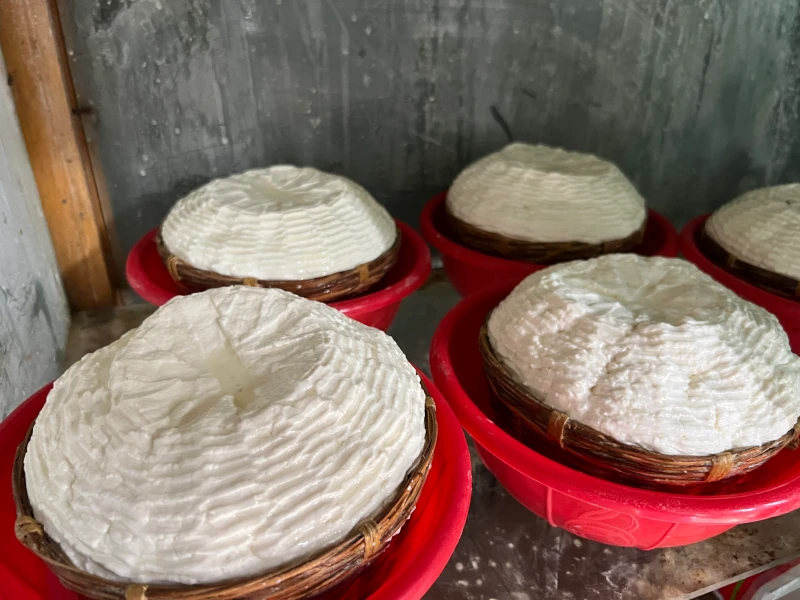
That yield tells you something important. This is not an efficient product. Ten kilograms of milk for one kilogram of cheese. It takes a great deal to make a small amount. The bamboo mould gives it its shape — that distinctive dome, those ribbed sides, the circular pattern pressed into the top. No two wheels are identical. Every basket is handmade. Every wheel is slightly different. That is not a flaw. It is the nature of something genuinely handcrafted.

The artisan’s hands. The original basket. The red plastic bowl that has been part of this trade for as long as anyone can remember.
The result is a soft, slightly salty white cheese that is firm enough to hold its shape and moist enough to squeak when you bite it. The salt level is intentional — enough to act as a preservative, enough to make you reach for another piece, never overwhelming. It is eaten as it is — sliced plain, fried golden, crumbled into rice, softened under hot dal. It has its own culture of eating, developed over centuries alongside the people who made it.
It is nothing like Indian paneer. Paneer is denser, drier, largely flavourless on its own, and designed primarily for cooking — it holds its shape in curries and absorbs sauces. Aushtogram ponir is a different thing entirely. It is eaten for itself. It has flavour, texture, character. It squeaks. It has eyes — those small internal holes that form naturally during the process and tell you something real is happening inside. It is a cheese with a personality.
The makers
The craft has been passed down through families for generations. One artisan, who has been making cheese since childhood, traces his family’s tradition back nearly three hundred years. The knowledge moves from father to son, from uncle to nephew, from one generation to the next — not through books or formal training, but through watching, doing, and repeating.
Reports suggest around fifteen registered cheesemakers currently operate in Aushtogram. This is almost certainly an undercount. Many families produce informally, as they always have, outside any official registry. And beyond Aushtogram itself, the tradition has spread. Cheesemakers now operate across Bangladesh — in Kishoreganj, in Dhaka, and in other districts — producing cheese inspired by the Aushtogram method.
This is where it gets complicated. Walk through any market in Dhaka today and vendors will tell you they are selling Aushtogram ponir. This is not always true. The name has become so associated with quality that it has been borrowed freely — sometimes by producers making genuinely good cheese using the traditional method, sometimes by those making something quite different. Quality varies enormously. The buyer has no easy way to know what they are actually getting.
This is precisely why the GI certification matters.
The recognition
There is a saying in Kishoreganj that has been passed down for generations: “Haor-baor mache bhora, Kishoreganjer ponir sera” — the haors abound with fish, but Kishoreganj’s cheese is the best.
For a long time that pride was purely local. People in Kishoreganj knew what they had. The rest of the world did not.
That changed in April 2025, when the Department of Patents, Designs and Trademarks under Bangladesh’s Ministry of Industries formally awarded GI status to Aushtogram cheese — Geographical Indication certificate number 48.
GI stands for Geographical Indication. It is the same international protection that means Champagne can only be called Champagne if it comes from the Champagne region of France. Darjeeling tea. Parmigiano-Reggiano. Roquefort. These are not just names — they are protected designations that say this product, from this place, made this way, is in a category of its own. Now Aushtogram ponir carries that same recognition. Only cheese made in Aushtogram by registered producers can legally carry that name.
The makers who have been doing this quietly for generations — the families who watched their fathers and taught their sons — now have something official behind them. The world is finally paying attention.
Why I call mine Ottawagram Ponir
I want to be clear about something important.
What I make in Ottawa is not Aushtogram ponir. It cannot be. The milk is different. The water is different. The grass the cows ate is different. The hands that made it, the air it was made in, the seasons it was shaped by — all different. The GI certification means that name belongs to Aushtogram and to the families who have kept this craft alive for centuries. It is theirs. I would not claim it.
What I make is inspired by Aushtogram ponir. Taught by people who learned from people who learned before them. Made with the same bamboo basket shape, the same curdling method, the same salt, the same intention. But made here, in Ottawa, by someone who grew up eating it and missed it so much that he taught himself to make it.
I call it Ottawagram Ponir because the name carries both places at once. Aushtogram, where the tradition lives. Ottawa, where I live now. The name itself tells the whole story.

Ottawa. My kitchen. Eight wheels. The tradition continues — twelve thousand kilometres from where it began.
Journal Entry 02. The next entry goes deeper — into the history of Aushtogram ponir, the Mughal origins of the name itself, and the long journey from the haors of Kishoreganj to the tables of Bengal’s aristocracy. If you have memories or family stories connected to this cheese that are not written down anywhere, I would genuinely like to hear them. Write to me at ottawagramponir@gmail.com
“From the Haor to Here. One batch at a time.”
Read all journal entries →