The Ponir Journal
Journal Entry · 03
A Four Hundred Year Journey

Every food has a history. Most of that history goes unrecorded — passed from one generation to the next by word of mouth, changing a little with each telling, until the line between what happened and what is remembered becomes impossible to draw. The history of Aushtogram ponir is like this. Parts of it are documented. Parts exist only in the memory of the artisans who have been making it for centuries. And parts, I suspect, have already been lost. What follows is my attempt to gather what I have found — from published sources, from artisan testimony, and from stories told to me in Aushtogram — and to be honest about what each of them is.
Before the cheese — the saint and the cows
To understand why Aushtogram ponir tastes the way it does, you have to go back further than the cheese itself — to the conditions that made the milk exceptional before anyone thought to make cheese from it.
Hazrat Kutub Shah was one of the 360 Awlias — saints — who accompanied Hazrat Shah Jalal to Bengal in the 14th century to spread Islam across the region. Shah Jalal’s arrival in Bengal is one of the most significant moments in the history of what is now Bangladesh. The saints who came with him left marks across the land that are still felt centuries later. Hazrat Kutub Shah was among the most revered of them. A mosque bearing his name — the Qutb Shah Mosque, a 16th century structure whose terracotta frieze still stands — exists in Aushtogram. Whether his connection to the place was direct or whether the mosque was built in his honour by followers, his name and memory are part of the fabric of Aushtogram.
What the artisans of Aushtogram will tell you is this: there is a longstanding prohibition, rooted in religious tradition, against using milking cows for tilling the soil. This may not have been a rule specific to Aushtogram — it may have been a broader practice observed across the Muslim communities of the region. But in Aushtogram, the people credit this tradition as one of the reasons their milk has always been of exceptional quality.
Think about what it means in practice. A milking cow that is never used for field labour lives differently. It is not exhausted by agricultural work. It grazes freely on the rich, fertile grass of the haor floor. It produces calves and milk and nothing else. Generation after generation, this practice shaped the cattle of Aushtogram — and through them, the milk. And through the milk, the cheese.
Ponir Khan — the Mughal officer who gave the cheese its name — came much later, in the 16th or 17th century. By the time he arrived and tasted the milk of Aushtogram’s cattle, that milk had already been shaped by generations of careful, religiously informed husbandry. The conditions for an exceptional cheese had been building for centuries before anyone made one.
The name
The word “ponir” itself has a story.
According to the most widely documented account of the cheese’s origin, a Mughal army officer named Ponir Khan — son of Delwar Khan — visited the cattle herds of Aushtogram approximately four hundred years ago, during the Mughal period in Bengal. He tasted the milk, recognised its quality, and made cheese from it with his own hands. The cheese he made spread. The craft took root. And the name of the man who first made it became the name of the thing itself.
Ponir. The word we use across Bangladesh for this cheese — the word I use in the name Ottawagram Ponir — comes from a Mughal army officer who stood in the haors of Kishoreganj four centuries ago and decided to make something from what he found there.
Kishoreganj was deeply embedded in the Mughal world. A 16th century mosque — the Qutb Shah Mosque, named after the very saint whose prohibition shaped the milk — still stands in Aushtogram, its terracotta frieze intact, testimony to what was built in this remote wetland place. This was not a forgotten backwater. It was a place where Mughal officers travelled, where mosques were built, where a cheese tradition was born.
There is a competing theory, worth noting honestly. Some scholars of Bengali food history argue that cheese was introduced to Bengal not by the Mughals but by the Portuguese — the first European traders in the region, who arrived approximately four hundred years ago and are said to have made cheese for the long return voyage to Portugal, teaching the technique to locals along the way. It is possible that both stories contain truth. The Portuguese may have introduced the concept of curdled cheese to Bengal at roughly the same time that Ponir Khan was experimenting with the milk of Aushtogram’s cattle. History is rarely tidy.
The craft spreads
The earliest documented commercial production of Aushtogram ponir is associated with the Dutta family of Dattapara — a Hindu family who, according to artisan testimony, first organised the making and selling of the cheese on a commercial scale. From them the craft spread to other families in the upazila, becoming the cottage industry it remains today.
That the original commercial producers were Hindu is worth noting. Aushtogram ponir crosses lines that food in the subcontinent sometimes does not. It was made by Hindu families, shaped by a Muslim saint’s prohibition, named after a Muslim army officer, and eaten with equal enthusiasm by everyone. Food, at its best, does that.
The journey to the courts
At some point — and here we move firmly into the territory of oral history — Aushtogram ponir left the haors and began to travel.
Published accounts record that during the Mughal period, the cheese made in Aushtogram was supplied to the Shahi Darbar — the royal court — in Delhi. How it got there, through whose hands, by what route across the vast subcontinent, is not recorded. But the claim exists in print, and it is consistent with what we know: that the Mughal Empire had deep roots in Kishoreganj, that the region was connected to the wider Mughal world, and that this was a cheese remarkable enough to travel.
Closer to home, the artisans of Aushtogram will tell you that their forefathers supplied cheese to the Nawabs of Dhaka — the aristocratic family who presided over Bengal’s capital and were among the most powerful and cultured patrons of their era. The Nawabs were known for their refinement, their hospitality, and their table. It is entirely plausible that a cheese of this quality found its way to their kitchens.
There is another story, told by the artisans, that a Nawab of Calcutta — a lover of all kinds of cheese — once tasted Aushtogram ponir made from the milk of cows that had grazed on the haor grass. He was so taken with it that he made it known across India, spreading its reputation far beyond Kishoreganj. No name is attached to this story. No date. It has been passed down through the generations of cheesemakers and has no doubt changed with each telling. I record it here because it deserves to be recorded, not because I can confirm it.
What all of these stories share — the Shahi Darbar, the Nawabs of Dhaka, the Nawab of Calcutta — is the same underlying truth: this cheese, from this remote and difficult-to-reach place, was good enough that powerful people wanted it. That does not happen by accident.

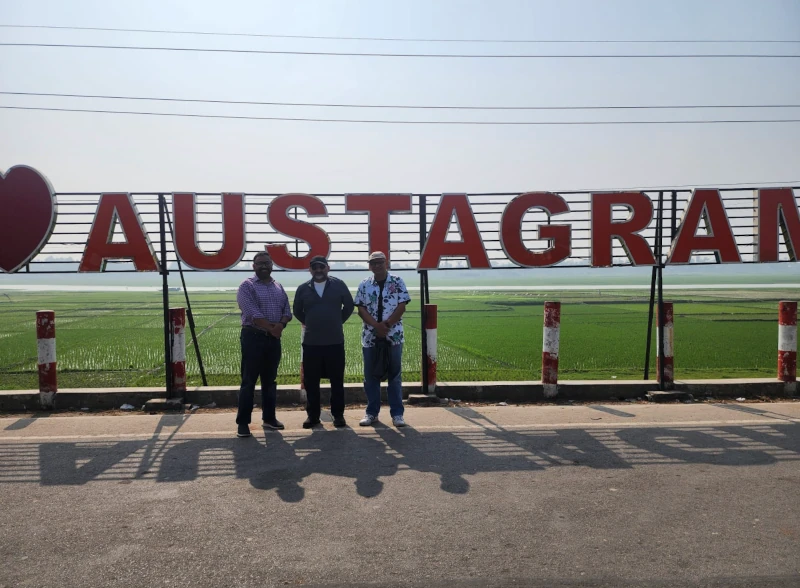
The haor at dawn. The landscape that produces the grass, that feeds the cows, that makes the milk, that makes the cheese. Seven hundred years of this, and counting.
The present and its difficulties
The craft survives today, but not without strain.
The number of registered producers in Aushtogram is small — officially around fifteen, though the real number of families producing cheese, formally and informally, is certainly higher. More significantly, the supply of milk from the haor region has been declining. The vast seasonal flooding that once made the haor floor extraordinarily fertile is changing. Cattle numbers are not what they were. The milk that defined this cheese — from cows that grazed freely on haor grass, that were never used for labour, whose quality was shaped by centuries of practice and one saint’s prohibition — is harder to source in the quantities needed to meet demand.
This scarcity, as much as the cheese’s popularity, explains why production has spread across Bangladesh. Cheesemakers in Dhaka, in other districts, across the country, are making cheese inspired by the Aushtogram method. Some of them are making it well. Some are not. The name Aushtogram ponir has been borrowed so freely that it has become almost meaningless in the market — a label of aspiration rather than origin.
The GI certification, awarded in April 2025, is a formal attempt to address this. To say: this name belongs to this place. To protect what remains of the original craft, and to give the artisans who have kept it alive something to stand behind.
Whether it will be enough is another question. GI status protects a name. It cannot restore a declining milk supply. It cannot bring back the herds that once grazed on the haor floor. It cannot make the flooding seasonal again, or reverse whatever combination of climate, development, and changing land use has reduced the pastures that made this milk what it was.
What it can do is draw attention. And attention, at least, is something.
What this means to me
I grew up eating this cheese without knowing any of this history. I ate it because my mother put it in front of me, because it tasted like nothing else, because it was simply part of what food meant in our family. The saint, the Mughal officer, the Nawab who spread its fame, the Dutta family who first sold it commercially — none of this was something I knew.
I know it now. And it changes something about the act of making this cheese in my Ottawa kitchen. Every batch I make is connected — however imperfectly, however distantly — to a tradition that stretches back through the Nawabs of Bengal, through the Mughal courts, through the 14th century arrival of a saint who told the farmers of Aushtogram to let their cows live well.
I am not claiming that lineage. I am not Aushtogram. My cheese is not their cheese. But when I press a wheel into a bamboo basket and leave it to set, I am doing something that has a history. A long, complicated, imperfectly documented, genuinely remarkable history.
That is worth knowing. And worth writing down.
Journal Entry 03. Much of this history remains unwritten in English. If you have stories, memories, or family knowledge connected to Aushtogram ponir — stories you heard from parents or grandparents, things you remember from visits to Kishoreganj, anything at all — I would genuinely like to hear them. Write to me at [email protected]
“From the Haor to Here. One batch at a time.”
Read all journal entries →